Chainsaw carburetors are simple. It has a job to do. It meters tiny amounts of fuel. Mix fuel and air. This mixture is required for engine operation.
If you make a mistake, you can damage the engine.
Too little fuel? The engine runs lean. It may not start at all. In two-stroke engines, fuel is also used to lubricate parts. No fuel means grinding metal on metal. This will damage the piston. You might even seize the engine completely.
Too much fuel? The engine runs rich. It floods. Smoke pours out. It bogs down under load. It stalls when you need power. It wastes gas and leaves black soot residue everywhere.
The carburetor’s only real job is to getting that ratio right.
Why chainsaw carbs are simpler than car carbs
Most car carburetors are complicated machines. They handle hundreds of gradations from idle to full throttle. Accurate acceleration, cruising speed and highway speed are required.
A chainsaw doesn’t care about nuances. Operators want one of three things:
- Start a cold engine.
- Keep it idling while waiting.
- Blast it wide open to cut wood.
that’s it. Nobody cares about the difference in performance between idle and full throttle. You don’t drive on the highway. You cut branches. Carbohydrates only need to cover these three different situations. Because of this simplicity, you don’t need a degree in mechanical engineering to often repair and adjust it yourself.
Visualizing the Parts
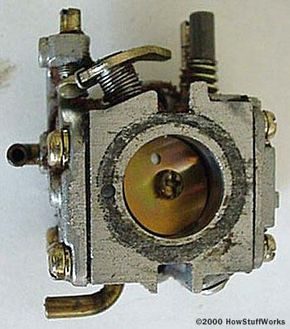
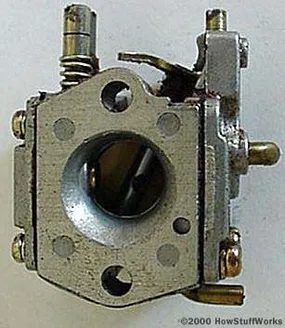
The actual carburetor can be seen in the picture below. Look at the components. Pay attention to how the fuel lines are connected. See the adjustment screws. This information is important when you begin to diagnose why your saw won’t start or why it’s constantly flooding.
The carburetor’s only real function is to maintain the correct fuel-air ratio. If you make a mistake, you can damage the engine.
How the carburetor controls fuel at different throttle positions
You can watch it briefly in the video link above, but let’s take a closer look at how it works in practice. You are looking at the tube. that’s it. A hollow cylinder where air and fuel are mixed before entering the engine.
There is an adjustable plate on the inside of the tube. This is called a throttle plate. Usually a brass plate. Move upwards for more air circulation. If you want to restrict the flow, go down. You can see this round brass plate in picture 1.
As you go down the pipe, the passage narrows. This is a Venturi tube. You can see it in Figure 2. As air passes through this bottleneck, the pressure drops. A vacuum is formed. In the middle of that narrow spot is a small hole called Jet. The vacuum draws fuel through the jet and into the air stream. See the jet to the left of the venturi in picture 2?
Adjust full throttle performance
The carb works well if you floor it. The throttle plate opens parallel to the length of the pipe. maximum airflow. This creates a strong vacuum inside the venturi. It sucks a precisely measured amount of fuel from the main jet.
Look at the top right corner of the carb in picture 1. Do you see those two screws there? They are not just for show.
The screws on the box of the chainsaw are marked “Hi”. This controls the Hi-speed jet. Determines the amount of fuel that flows into the venturi when it is run at full throttle. If you do this wrong, your engine will lean or flood. This is a subtle adjustment.
Understanding the principles of idle circuits
Go ahead and kill the power. Allow the engine to idle. The throttle plate is almost completely closed. Air flow through the venturi is negligible. There is no vacuum.
But here’s the trick. There is a huge vacuum behind the almost closed throttle plate. This restriction creates a suction zone. Cut a small hole in the side of the carb tube and use suction. Fuel is drawn in through this hole.
This is an idle jet. This operates independently of the main venturi vacuum. The second screw of the pair in picture 1 is marked “Lo”. This adjusts the Lo-speed jet. Adjusts the fuel supply at idle.
A cold engine is a completely different animal.
Why do you need a choke plate?
Pull the starter cable on a cold engine. The rotation speed is lower. Metal is cold. The fuel does not evaporate properly. You need a rich mixture to get things going. If you don’t, you just die.
Enter the choke plate.
When you pull the choke, the plate slides to completely cover the venturi. Block air ducts at the most critical points. If the throttle is wide open and the venturi is blocked, the vacuum inside the engine can cause a strong pull on the fuel line. The fuel is sucked from the main jet and the idle jet at the same time.
result? A very rich blend.
This large amount of fuel usually fires the engine once or twice. It run very slowly and can emit exhaust fumes. But it’s alive. When it is hot enough, open the choke. Venturi is revealed again. Air flow returns to normal. The engine enters the normal operating cycle.
Try starting the cold saw without the choke. It can take 5 minutes of pulling the rope before you give up. The physics of vacuum and confinement don’t care about your patience. All they care about is airflow.