Power saws are dangerous. They should be. If you treat them with disrespect, they will maim you or ruin your materials in seconds. You need to respect the blade. Wear goggles. Push the wood, don’t let the wood pull you. But once you make ten practice cuts on scrap lumber, the fear evaporates. You get a rhythm. You get confident.
Before you buy or rent, you need to know what you are looking at. Not every cut needs the same tool. Using the wrong saw is a waste of time and money. Here is how the three most common handheld power saws differ so you can match the tool to the task.
Mastering the Versatile Circular Saw
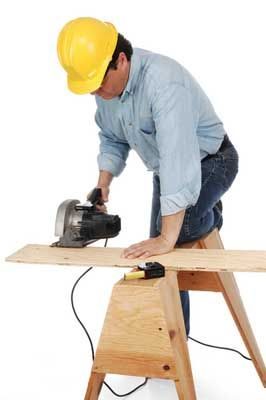
The circular saw is the workhorse of the renovation world. It is adaptable. You can swap out blades to slice through plywood, cut 2x4s, or even tackle masonry if you have the right disc. It is not limited to straight lines either. You can tilt the base plate to cut angles. This makes it ideal for miter cuts on trim or framing.
Some models are heavy enough to be mounted into a stationary setup, effectively turning them into a table saw for more precise crosscuts. If you are framing a wall or cutting sheets of drywall, this is likely your go-to. It is fast. It is aggressive. It gets the job done.
Precision Shaping with the Saber Saw
Also known as a jigsaw, the saber saw is for when straight lines are the enemy. This tool uses a blade that moves up and down rapidly. It allows for intricate curves and complex shapes. You can cut out a hole for a sink or a decorative pattern in a cabinet door.
It is smaller than a circular saw. It is lighter. It gives you control over tight spaces where a big round blade won’t fit. If your project involves curves, cutouts, or delicate details, the saber saw is the correct choice. It does not rip through wood like a circular saw; it guides you through it.
Heavy-Duty Demolition with the Reciprocating Saw
Think of the reciprocating saw as the big brother to the saber saw. It is larger. It is more powerful. It has additional handles for two-handed control and variable speeds to manage torque. This is a demolition tool. You use it to cut through nails, pipes, or rotting wood during a tear-down.
It is not for fine carpentry. You will not use this to build a bookshelf. But if you need to cut through a 2×4 that has a nail in it, or slice through PVC pipe in a cramped crawl space, the reciprocating saw handles the abuse. It is built for control under pressure.
Other Essential Tools to Consider
Power saws are just one part of the equation. A well-stocked workshop requires a mix of power and manual tools.
- Home Repair Tools: Review the full spectrum of tools available. You might not need a saw for every job. Sometimes a drill or a sander is all you need for simple improvements.
- Hand Tools: Never underestimate the hammer, pry bar, or screwdriver. These are foundational. They allow for basic fastening and prying without the noise and dust of power tools.
- Materials Knowledge: The material