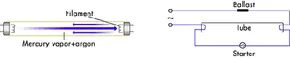
Most people think of lightbulbs as simple glass tubes, but the mechanics inside a fluorescent tube are surprisingly complex. Unlike an incandescent bulb, there is no glowing filament here. Instead, you have mercury vapor inside. When ionized, this vapor emits ultraviolet light. That invisible UV ray hits the phosphor coating on the inside of the glass, causing it to fluoresce and produce visible light.
To get this chain reaction started, you need a fluorescent starter.
If your light is flickering or refusing to turn on, the starter is often the culprit. It is a small, cylindrical component, usually found in a socket at the end of the fixture. Understanding how it works can save you a trip to the hardware store—or at least help you fix the problem faster.
The Role of the Fluorescent Starter in Circuit Ignition
The starter acts as a timed switch. When you flip the wall switch, voltage rushes into the circuit.
At this moment, the starter is a closed switch. Current flows through the filaments at both ends of the tube. These filaments heat up, creating a cloud of electrons inside the glass.
But the starter isn’t just a passive wire. It contains a small gas-filled tube with bimetal contacts. The current passing through heats these contacts. After about one or two seconds, the heat causes the bimetal strip to bend, opening the circuit.
This sudden break in current is critical. The starter’s contacts open, interrupting the flow. Because the ballast is inductive, this interruption creates a voltage spike—an “inductive kick.” This spike forces a stream of electrons across the tube, ionizing the mercury vapor and lighting the lamp.
Once the tube is lit, it has low resistance. The ballast then takes over as a current limiter. The starter remains open because the voltage drop across the tube is no longer high enough to trigger the glow discharge again.
Without the starter, a steady stream of electrons is never created between the two filaments, and the lamp flickers. Without the ballast, the arc becomes a short circuit, which can vaporize the filaments or cause the bulb to explode.
Why Your Light Might Be Flickering
If you see your fluorescent tube blink repeatedly before turning on, the starter is trying and failing. The contacts close and open in a loop. This happens because the “inductive kick” wasn’t strong enough to fully ionize the gas on the first try. The process repeats until the voltage builds up or the starter fails.
Older starters are called “glow tube starters.” They look like a small aluminum can with a two-pin base. Inside, there is a neon or argon gas tube and sometimes a radio frequency interference (RFI) suppression capacitor.
While these starters are physically interchangeable across many fixtures, the wattage matters. You must match the starter’s rating to the wattage of the fluorescent tubes. A mismatch can lead to unreliable operation and a shorter lifespan for both the starter and the tube.
Signs It Is Time to Replace the Starter
How do you know if the fluorescent starter is dead?
- Flickering: The light blinks repeatedly before starting.
- Slow Start: The tube takes an unusually long time to illuminate.
- Inconsistent Lighting: The light is dim or unstable.
- Black Ends: If the ends of the tube are turning black, the lamp is rapidly switching cycles. This usually points to a failing cathode inside the tube itself, but a bad starter can accelerate the wear.
If your tubes aren’t igniting efficiently, replace the starter. It is one of the cheapest and easiest DIY fixes you can perform.
Can Fluorescent Lights Work Without a Starter?
Some modern fixtures do not use a separate starter. These systems rely on a ballast with extra windings. The ballast constantly supplies a small amount of voltage to heat the filaments. This preheats the cathodes, allowing the lamp to strike without the mechanical opening and closing of a starter switch.
If you are troubleshooting an older fixture with a visible starter can, however, you still need it. Removing it will likely result in a light that never turns on.
LED vs. Fluorescent: The Efficiency Gap
You might be wondering if you should even bother replacing the starter or if you should just switch to LEDs.
LEDs are generally superior to fluorescents. They are more energy-efficient and generate more lumens per watt. An LED lifespan often exceeds 50,000 hours. Compare that to fluorescents, which consume one-third to one-fifth the power of older incandescents but still rely on mercury and fragile glass. LEDs also offer a greater range of wavelengths, providing better color rendering.
If your fixture is old and the starter keeps failing, consider the long-term cost. However, if you just want the light on now, swapping out that small aluminum can is a quick, hands-on solution. Just remember to turn off the power at the breaker before touching anything.