
You know the drill. Wash, rinse, repeat. Then comes the part where you wait for your hair to air dry, or you grab the hair dryer to speed things up. Science tells us that wet hair doesn’t cause colds, but sitting around with a dripping scalp is miserable. Especially in winter. So you plug in the machine. It blows hot air. Your hair dries. Simple, right?
It is simple until you look inside.
Hair dryers, or blow dryers, have been around since the 1920s. Early models were essentially fire hazards. People dropped them into sinks. They got electrocuted. It wasn’t safe. Today, the design is more refined. But the basic physics remain the same. You have a motor. You have a fan. You have a heating element. You put them together, and you get hot air.
The Mechanics of Hot Air
At its core, a hair dryer is an appliance that accelerates water evaporation. It does this by blowing air over a heating element. The air gets warm. The air hits your wet hair. The water turns to vapor. You are left with dry hair.
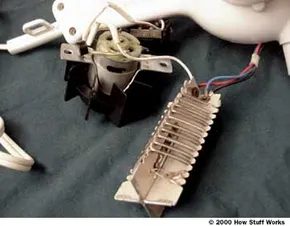
The heating element is usually a bare, coiled wire. It sits inside the housing. When electricity flows through that wire, it encounters resistance. Resistance creates heat. The wire glows. It gets hot.
Then the fan comes in. A simple motor-driven fan sits behind or in front of that coil, depending on the design. It pulls room-temperature air in. It pushes that air over the glowing wire. The air heats up instantly. It shoots out the nozzle. It hits your hair.
Without the fan, you’d just have a hot wire in a tube. You’d burn your hand. You might start a fire. The fan moves the heat. It distributes it. It makes the process efficient.
Safety Features and GFCI Plugs
Early hair dryers lacked basic protections. Modern ones have them because the law requires them. In the United States, federal law since 1991 mandates that all portable hair dryers must include a Ground Fault Circuit Interrupter, or GFCI.
This isn’t just a preference. It’s a life-saving measure. The GFCI is the larger, polarized plug you see on the cord. It looks different from a standard two-prong plug. It’s bulkier. It has test and reset buttons on some models.
A GFCI monitors the current running through the circuit. If it senses a leak, it trips immediately.
Here is how it works. The plug measures the current going out through one slot of the wall outlet and the current coming back through the other. They should be equal. If they aren’t, current is leaking somewhere. Usually into the water. Usually into your body. The GFCI cuts the power. It trips the circuit. You don’t get electrocuted.
This protection works whether the dryer is on or off. It works as long as it’s plugged in. It stops the flow before the current can harm you.
What Happens When Water Meets Electricity
You might think, “What if I drop my dryer in the tub when it’s not plugged in?”
You won’t get electrocuted. There’s no current. The circuit is open. But you will likely ruin the dryer. Water gets inside the housing. It hits the motor. It hits the heating coil. It hits the wiring. Corrosion sets in. The components short out. The dryer stops working.
So, don’t drop it. Plugged in or not, water and electronics don’t mix. You risk damaging the device. You risk creating a hazard for when you plug it back in later.
Why Won’t You Sizzle?
You’ve probably wondered how the dryer blows hot air without burning your scalp. It’s not magic. It’s engineering. The fan moves air fast enough that the heat dissipates before it cooks your
Grab any basic model from a discount bin and you’ll see the same dual-switch layout. One toggle flips the power on. The other regulates airflow speed. Higher-end units add a third switch to dial in temperature, but the core mechanics remain stubbornly simple.
The goal is evaporation. Hot air raises the temperature around each strand. Warm air holds more moisture than cold air, pulling water out of your hair faster. It also helps water molecules break their own attraction, shifting from liquid droplets to gas.
Thousands of patents have been filed since the invention. Most just redesign the plastic shell. The internal engine hasn’t changed much. Safety features improved. The physics stayed the same.
To create that drying blast, you only need two components:
- A motor-driven fan
- A heating element
These parts convert electricity into convective heat. The process is linear.
When you plug in the unit and hit the switch, current flows. It hits the heating element first. In budget models, this is a bare coiled wire. Premium versions might use tourmaline-infused ceramic coatings for better heat distribution, but the function is identical.
Then the current spins the small electric motor. The fan turns. Air gets sucked in and pushed down the barrel. It flows through the heating element. The air heats up via forced convection. The hot stream exits the nozzle.
That’s the heat generation. The next step is moving that heat effectively.
Hair Dryer Air Flow
The fan isn’t just moving air. It’s creating pressure. You need volume. Without sufficient airflow, the heat builds up inside the barrel. You risk burning the motor or melting the plastic housing. Most modern dryers include thermal fuses to cut power if it gets too hot. But relying on that is a bad strategy.
Good airflow ensures even drying. It prevents hot spots that damage hair cuticles. The design of the barrel matters. A smooth interior reduces turbulence. Turbulence creates noise and inefficient pressure. Cheap dryers rattle because their fans are unbalanced or poorly shielded.
Where the air enters matters too. Intake vents are usually on the handle or rear cap. If you clog these with lint or dust, the motor struggles. It draws more current. It runs hotter. Clean the filters regularly.
Which type of fan is best? Axial fans are common because they move large volumes of air at low pressure. Centrifugal fans create higher pressure but less volume. Most hair dryers use axial designs. They’re quieter and cheaper to manufacture. If you hear a whining sound, the bearings are likely wearing out.
Temperature control isn’t just about comfort. High heat damages proteins in your hair. Keratin breaks down at high temperatures. That leads to brittleness and split ends. Why pay for a high-end dryer if you blast it on maximum heat?
The switches allow you to decouple speed and heat. Use high airflow with low heat for thick hair. Use low airflow with high heat for fine hair. It’s about efficiency. You’re not trying to cook your scalp. You’re trying to evaporate water before the surface tension holds onto it.
Consider the nozzle attachment. It concentrates the stream. That’s useful for styling. It’s not necessary for drying. In fact, concentrating the heat can scorch sections of hair. Start with a wide diffuser or no nozzle at all. Let the air spread out.
Safety is another factor. Grounded plugs are standard in most countries. Two-prong plugs are fading out. If you plug a dryer into a wet bathroom outlet, you risk electrocution. The water conducts electricity. Keep the plug dry. Keep the cord away from the shower. It seems obvious. People still ignore it.
The heating element
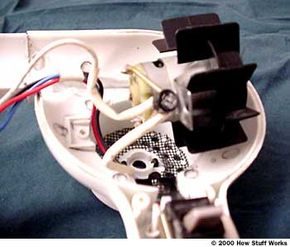
You might wonder how a handheld device moves so much air. The secret lies in the fan. It looks a bit like a tiny hydraulic turbine or a water wheel. But instead of using flowing water for power, this fan uses electricity to push air. The motor sits right inside the fan assembly. It is attached firmly to the tip. When you flip the switch, the motor and fan spin together.
The blades create centrifugal force. This pulls air into the unit. The air enters through small round air inlets on the side casing. You will notice a safety screen over these holes. That mesh prevents your hair or loose threads from being sucked into the blades. Once inside, the air is pushed straight down the barrel.
Most models offer high and low airflow settings. The manual might call this high or low speed. The difference comes down to how fast the motor turns. You control this by changing the current in the circuit. Low power means the motor spins slowly. Less air moves through the dryer. More power makes the motor speed up. The fan rotates rapidly. It draws in more air and increases the flow.
Newer, pricier dryers add something else. They blow hot air mixed with ions. These are charged particles. Manufacturers say this technology dries hair faster. It also claims to reduce static. Less static makes hair smoother and shinier. It should be easier to manage and attract less dust. You will find ion generators in different designs. Their location varies within the unit.
Things get hotter when we look at the heating element.
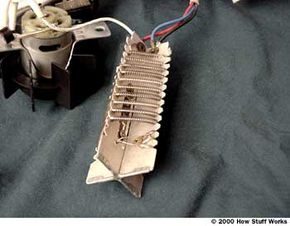
How Nichrome Wires Actually Heat Your Hair
Most standard hair dryers rely on a simple but effective mechanism. Inside the casing, you’ll find bare nichrome wire coiled around insulating mica boards. This wire isn’t just random metal; it’s an alloy of nickel and chromium. You see this same material in toasters and curling irons because it plays two critical roles in generating heat.
First, nichrome is a poor conductor of electricity compared to copper. This resistance is exactly what you want. When current flows through it, the friction generates significant heat. Second, it doesn’t oxidize easily. If you used iron, it would rust and burn out at those high temperatures. Nichrome stays stable.
The airflow does the heavy lifting here. The fan pushes cool air into the barrel, forcing it against the hot nichrome coils. Heat transfers from the wire to the air. As that heated air moves out, cooler air rushes in to take its place. It’s a continuous cycle of convection.
Wattage and Heat Output
How hot does that air get? It comes down to power and time.
Early models were weak, pushing out only about 100 watts. Today’s high-performance units can hit 2,000 watts. That extra power dries hair much faster. Higher wattage means more heat transferred to the airflow.
Many dryers offer high and low settings. These work by cutting off part of the circuit that feeds the heating element. Flip the switch, reduce the power, lower the temperature.
Time matters too. Air usually spends only about half a second in the heating barrel. If it stayed longer, the temperature would spike dangerously. Manufacturers limit this exposure to keep things safe.
Ceramic and Tourmaline Upgrades
You might notice ceramic-coated elements becoming more common. These coatings aim to heat more evenly. Some models even infuse the ceramic with crushed tourmaline. The claim is that this supports ion creation and better heat flow. Whether that actually makes a tangible difference for your hair health is debatable, but the technology is there.
Hair Dryer Safety Features
That brings us to the most important part. What stops these high-wattage devices from melting your bathroom counter or starting a fire? Hair dryers are packed with safety features designed to prevent overheating. They work behind the scenes to keep you safe while you style.
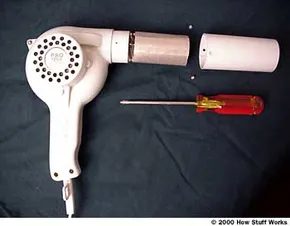
You probably just grab your dryer and blow. You don’t think about the engineering required to keep it from burning down your bathroom. But making a hair dryer for mass consumption is a nightmare of liability and physics. Manufacturers have to predict every way you might misuse the device. Then they build in guards against those failures.
We’ve already talked about ground fault circuit interrupters. If you missed that, go back. But there’s a whole other layer of protection inside that plastic shell.
The Heat Cutoff
Your scalp cooks at 140 degrees Fahrenheit. That’s roughly 60 degrees Celsius. Anything hotter and you’re looking at a bad day. Hair dryers can’t let the air near that limit.
So they use a safety cut-off switch. It’s usually a bimetallic strip.
Here is how it works: The strip is two different metals bonded together. Both expand when heated. But one expands faster than the other. So when the temperature spikes inside the dryer, the strip bends. It hits a switch. Power cuts. Motor stops. You stay safe.
“When the temperature rises inside the hair dryer, the strip heats up and bends because one metal sheet has grown larger than the other.”
It’s simple. It’s effective. It’s also why your dryer sometimes just stops working after a long session. It’s protecting itself. And you.
Thermal Fuses and Insulation
Sometimes a bimetallic strip isn’t enough. If the heat gets really out of hand, you need a thermal fuse. This is a one-way street for electricity. If the current and temperature get excessively high, the fuse blows. It breaks the circuit. Permanently. The dryer is dead. But so is the fire risk.
Then there’s the outside of the unit. Without proper insulation, the barrel would become an iron. You wouldn’t be able to hold it. Manufacturers line the plastic with a heat shield. It keeps the exterior cool enough to touch.
Lint: The Silent Killer
Air has to get in. The fan blades pull it in to cool the motor and heat the air. But they also pull in dust, hair, and lint.
You’ve seen the protective screens on the sides. They catch the debris. But if you ignore them, lint builds up. If that lint gets inside, it gets scorched by the heating element. It can clog the motor. The dryer overheats. The nichrome coil burns out. Or worse.
Newer models try to solve this with removable lint screens. They click out. You rinse them. It’s a small thing. But it’s the difference between a $50 dryer and a $200 one that lasts longer.
The Front Grill
Look at the end of the barrel. There’s a grill there. It’s not just for style. It’s a barrier. It stops small fingers. Or toothbrushes. Or hairpins. From touching the heating element.
Children are inquisitive. Adults are distracted. The grill is a physical barrier against stupid mistakes.
Choosing the Right Dryer for Your Hair Type
Technology has moved on. It’s not just about safety anymore. It’s about hair health.
Ionic and ceramic hair dryers are the new standard. They emit negatively charged ions. These ions break down water molecules faster. Your hair dries quicker. Less heat exposure. Less frizz.
How do you choose? Look for adjustable heat and speed settings. If you have fine hair, low heat and high speed is your friend. Coarse, thick hair? You might need that higher heat and the ionic boost. Ceramic plates distribute heat more evenly. Metal plates can create hot spots.
It’s a small investment. But your hair feels the difference. And so does the safety profile.
Finding the Right Fit for Your Hair
Picking a hair dryer isn’t just about wattage anymore. You have to look at the technology inside the barrel. Ceramic and tourmaline components are huge right now. They distribute heat evenly. This reduces hot spots that fry your cuticles. If you have thick or curly hair, this matters.
“Ionic technology helps break down water molecules for faster drying.”
Ionizing hair dryers use negative ions to neutralize positive charges in damp hair. The result? Less static. Smoother finish. It sounds like marketing fluff until you try it. But don’t buy the first one you see. Check the patents. Look at what engineers like Kazutoshi Kaizuka and Dan Rosati actually designed. These aren’t just buzzwords. They’re specific mechanisms.
Safety First: Don’t Get Shocked
Electricity and water don’t mix. This isn’t a suggestion. It’s the law. You need a Ground Fault Circuit Interrupter (GFCI) in your bathroom outlet. The U.S. Consumer Product Safety Commission (CPSC) made this clear in their fact sheets. GFCIs cut power in milliseconds if they detect a ground fault.
“Install a GFCI outlet to prevent electrocution risk.”
Don’t skip this. Old homes often lack them. Retrofitting costs a few bucks. Your life is worth more. Also, check for recalls. The CPSC mailing list updates weekly. A faulty dryer can be a fire hazard. Look for UL listing. Avoid cracked cords. If it smells like burning plastic, unplug it immediately.
Maintenance and Repairs
Hair dryers break. Motors burn out. Heaters fail. Sometimes you can fix them. But first, check if it’s under warranty. If not, look for portable repair guides. Engineering a portable hair dryer involves understanding the fan blade balance and the heating coil resistance.
If you’re handy, you can replace the heating element. But you need to know nickel-chrome alloys. These materials withstand high heat without oxidizing too quickly. Using the wrong wire will cause a short. Or worse. A fire.
For most people, replacing the whole unit is safer. But if you want to keep an old professional model, clean the intake filter. Clogged filters cause overheating. Use a toothbrush. Vacuum the vents. Simple maintenance extends the life of the motor.
Beyond the Bathroom
Your hair dryer has other uses. Think about DIY projects.
- Shrinking tubing : Heat shrink tubing for electrical work needs precise heat. A hair dryer works.
- Removing stickers : Heat loosens the adhesive. Peel off labels from jars.
- Drying paint : Quick touch-ups on small items.
But be careful. Don’t use it on flammable materials. And never leave it running unattended. The portable hair dryer is versatile. But it’s not a heat gun. Don’t push it past its limits.
Where to Look Next
If you want to dig deeper, check out the sources. David Evangelista wrote about buying the right dryer on CBS. Steven Garner explored ceramic patents. For technical specs, look at the Vision Systems Design article on circuit breakers by Winn Hardin.
- How Hair Coloring Works : Understand how heat affects dyed hair.
- What if I never cut my hair? : Curious about hair biology? Start here.
- Risk of electrocution : Read the CPSC reports. Seriously.
There’s also a list of professional comparisons on Misikko. They chart airflow vs. heat output. It’s dry reading. But useful if you’re serious about your routine.
The technology keeps evolving. New patents drop every year. Michelle Kampel’s work on ion-emitting ceramic materials is recent. Lee William and Shek Fai Lau’s designs for hot air blowers are older but foundational.
You’re not just buying a tool. You’re buying a piece of engineering. Make sure it fits your hair type. And your safety standards.