Spring is here. The garden is waking up. You see those green spears poking through the soil and think, I’ll wait a little longer to get bigger ones.
Big mistake.
That impatience to wait for “perfectly sized” asparagus is the most common error home gardeners make. You want a harvest that feels substantial. You want a prize-winning vegetable. But while you wait, the asparagus changes. It doesn’t just grow. It transforms. From tender treat to woody toothpick in a matter of hours.
If you miss the window, you aren’t harvesting a vegetable. You are harvesting sticks.
The Fast Growth of Spring Asparagus
Walking through a garden center like Botanic or Jardiland in April, you see rows of robust asparagus crowns. You buy them. You plant them. You wait.
The temptation is strong. Let nature take its course. Let it get “properly” big before you cut. It feels logical. More time equals more yield. Right?
Wrong.
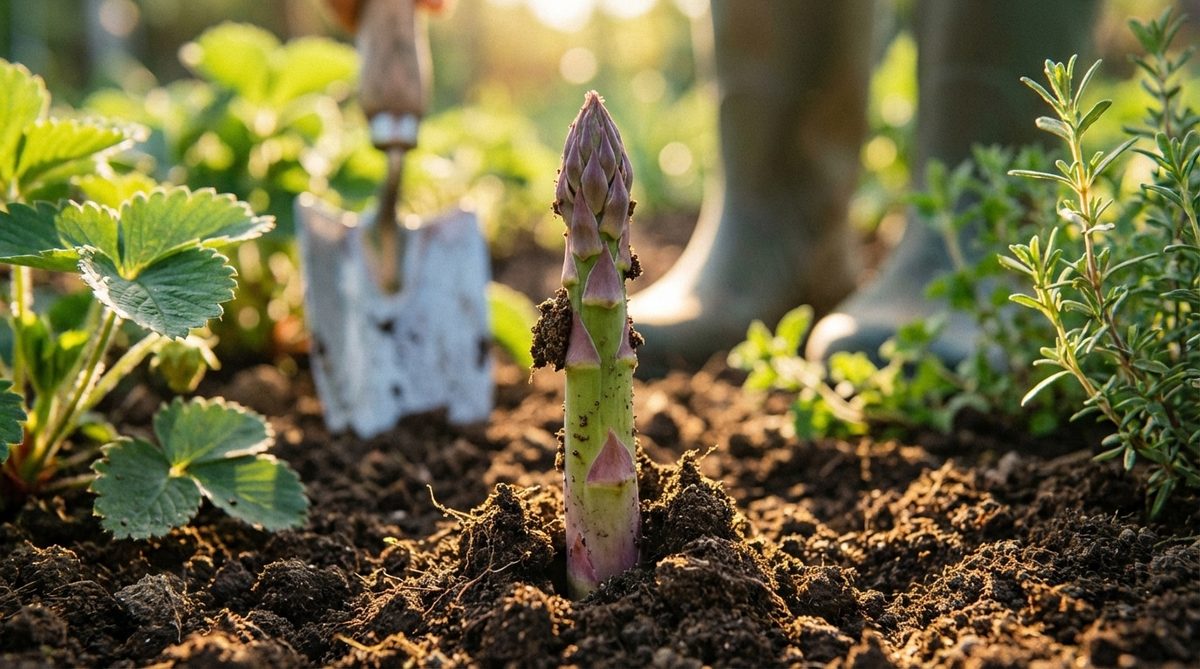
Asparagus (Asparagus officinalis ) grows at a frightening speed during spring. If the sun is out and the soil is warm, those spears can shoot up several centimeters in a single day. We don’t measure success in weeks for this crop. We measure it in hours.
The Golden Rule: 20 Centimeters
There is a specific moment when an asparagus spear is at its absolute peak. It’s not when it’s tiny. It’s not when it’s towering over the rest of the patch.
It is at approximately 20 centimeters.
Cut it too early, and you get a rachitic spear. It lacks substance. It’s underdeveloped. You are robbing yourself of the full flavor profile the plant has built up underground. It’s a missed opportunity for a proper meal.
Cut it too late, and the texture collapses.
At the 20-centimeter mark, the spear is firm yet tender. It is juicy and plump. This is the sweet spot. The balance of textures is perfect. Once you see a spear hit this height, you must cut it. Immediately. Do not wait for another spear to catch up. Do not wait until dinner time. Cut it now.
The Lignin Trap: Why Overgrown Asparagus is Unpleasant
Why does it go from delicious to inedible so fast?
Botanically, the plant is trying to survive. Once the spear breaches the surface, it needs to become a fern. It needs to reach for the sunlight to photosynthesize and support the plant for the rest of the year.
To do this, the plant begins synthesizing lignin.
Lignin is the same complex polymer that makes wood hard. It acts as structural cement for the plant. It reinforces the stem so it can stand upright. This is fascinating from a science perspective. It is disastrous for your palate.
As lignin builds up, the tender flesh becomes fibrous. Tough. Stringy.
You end up with a bundle of reeds in your bowl. No amount of boiling or steaming fixes it. The fiber remains. You chew. You pull. You get frustrated. The delicate, buttery mouthfeel you were hoping for is gone, replaced by a woody resistance that ruins the dish.
How to Harvest Without Hurting the Plant
So, how do you catch it at 20 centimeters?
You need to watch your garden. Constantly. This isn’t a “check it once a week” crop. It is a daily check.
Use the Right Tool
A sharp knife works. But a dedicated asparagus cutter or a specialized knife designed for this purpose is safer for the plant.
You want to cut the spear as close to the soil line as possible, but without damaging the crown (the underground bud system) or the surrounding emerging spears. A shallow, angled cut is best.
Protect the Crown
Damaging the crown this season hurts next year’s harvest. The plant stores energy in those underground bulbs. If you gouge too deep or cut too close to the main stem with a jagged tool, you invite rot and disease.
Keep the tool clean. Keep the cuts precise.
Don’t Wait for Uniformity
You might see one spear at 20 centimeters and three at 15. Cut the big one. Leave the smaller ones. They will continue to grow. You can return to them later in the day or the next day.
Forcing yourself to wait until all spears are the same size guarantees that the first ones you see will be over-mature and woody by the time the last ones are ready.
The Result: Pure Spring Flavor
When you get it right, the experience is different.
The spear snaps cleanly. The cut end releases a fresh, green aroma. Cooked simply—steamed or boiled—it melts in your mouth. It pairs perfectly with a light lemon vinaigrette or melted butter. It tastes like spring.
Get it wrong, and you have a salad of twigs.
The difference isn’t in the soil. It isn’t in the water. It is in the timing.
Your asparagus is growing right now. Go look. Is it at 20 centimeters? If it is, cut it. If it’s taller, it’s already gone past its prime.
Don’t let greed cost you the flavor.