Recent summers in the UK have been brutal.
Or rather, they’ve been relentlessly warm, pushing old brick and uninsulated loft spaces into uncomfortable stuffiness. Two of the bedrooms in our house face south. They trap heat. By August, they feel less like sleeping quarters and more like saunas. It makes me wonder why I hesitated to install air conditioning.
The hesitation wasn’t just about money.
It was the aesthetic. We picture those bulky, white boxes. Portable units sitting like unwanted guests in the corner, or wall-mounted split systems looming like office equipment. Ruined interiors.
But does it have to be ugly?
Experts say no. It’s usually bad planning.
‘Air conditioning can absolutely look good. But it has to be thought about. Most people choose a unit, find a spare bit of wall, and run pipes wherever is easiest. That is when it looks messy.’
Martyn Fowler of Elite Renewables says the problem isn’t the tech. It’s the afterthought mentality.
Kevin Pennington of Lancashire Air Conditioning agrees. He argues the UK market lacks sophistication here. We panic buy during heatwaves. We care about sleep, not design. The result is a reputation for eyesores that doesn’t reflect the available options.
Better boxes
The stereotype persists: all wall-mounted AC units look like cumbersome off-white rectangles. Fine for a cubicle. Terrible for a living room.
Modern units are slimmer. Cleaner.
Tom Houlker from Houlkair notes that flat fronts and soft edges help. Floor-mounted options sit low, mimicking slim radiators rather than dominating eye level.
Kevin Pennington has installed roughly 1,100 AC units. About 950 were standard white boxes.
‘They are white boxes,’ he admits.
But money buys choice.
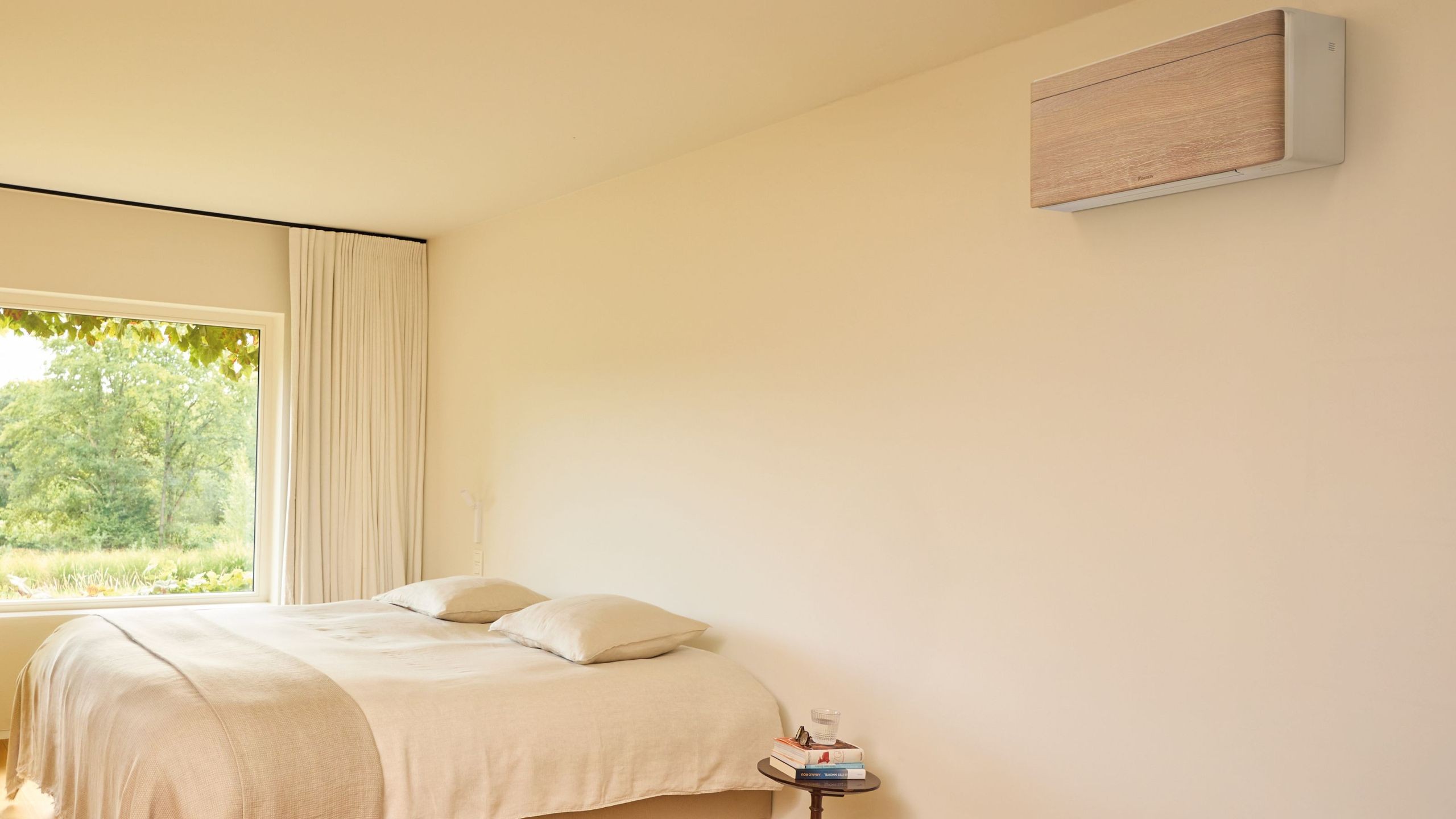
There are now dark finishes. Black glass. LG’s Artcool Mirror series uses smoked glass fronting. Toshiba offers the Haori unit with an interchangeable fabric cover—literally letting you change the ‘look’ like upholstery. Daikin has launched a ‘Stylish’ range featuring wood effect and leather-look finishes.
These units exist. You just have to know they are there.
Placement is everything
If you can’t open the walls for a concealed duct system, the wall-mounted unit must blend.
Size matters.
Martyn Fowler points out that a large unit in the center of a feature wall demands attention. It becomes the room’s focal point. Instead, align it with existing architectural lines. Top of a door frame. A wardrobe. Shelving.
‘Place the unit in line with something already there so it feels intentional, not randomly stuck.’
Sizing errors kill the vibe, too. An oversized unit cycles on and off rapidly. It’s noisy. It’s visible. A properly sized system runs quietly. It stays out of your mind.
Tom Houlker warns against hiding the unit badly. Boxing it in restricts airflow. It collects dust. Servicing becomes a nightmare.
Let it breathe.
Keep it tidy.
The ducted escape
If surface mounts still bother you, go deep.
Concealed ducted systems offer the cleanest aesthetic. You see only a grille. Maybe two.
Tom Houlker says this requires void space—a loft or a ceiling bulkhead. It changes the game for open-plan kitchens or period rooms where modern tech feels intrusive.
Martyn Fowler recommends this for main living areas. Route pipes through cupboards or loft spaces. Paint external trunking to match the brick. Hide what you can.
What about portables?
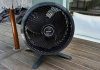
I recently tested the VonHaus 9000BTu portable unit. It worked. The bedroom cooled.
It also looked terrible.
A large plastic box with a hose dangling out the window like an IV drip.
Martyn Fowler says portable units are hard to make pretty. Chris Michael from Meaco admits the limitation. The physics of cooling require expelling hot air outside. That means a hose.
Meaco’s new Cirro range tries to help. Two-tone finishes create an illusion of smaller scale. Softer shapes. It’s better. But it’s still a machine.
Kevin Pennington suggests one drastic measure: drill a hole through the wall.
For £200-£3.00, an exterior vent kit replaces the window sash setup. It’s less intrusive. You lose a bit of window glass function, but the view remains intact.
Kerb appeal
It’s not just the interior.
Both portable and fixed units affect the exterior. Fixed units have outdoor compressors. These need placement.
‘Poorly routed trunking on exterior brickwork stands out immediately. White plastic on old stone looks bad.’
Plan it.
Check the side returns. The rear elevation. Tuck it away. Ensure airflow remains viable for the technician, but keep it out of sight for the street.
Air conditioning isn’t a fashion statement. It’s a utility.
But it doesn’t have to scream ‘utility’ at you while you’re trying to relax.